
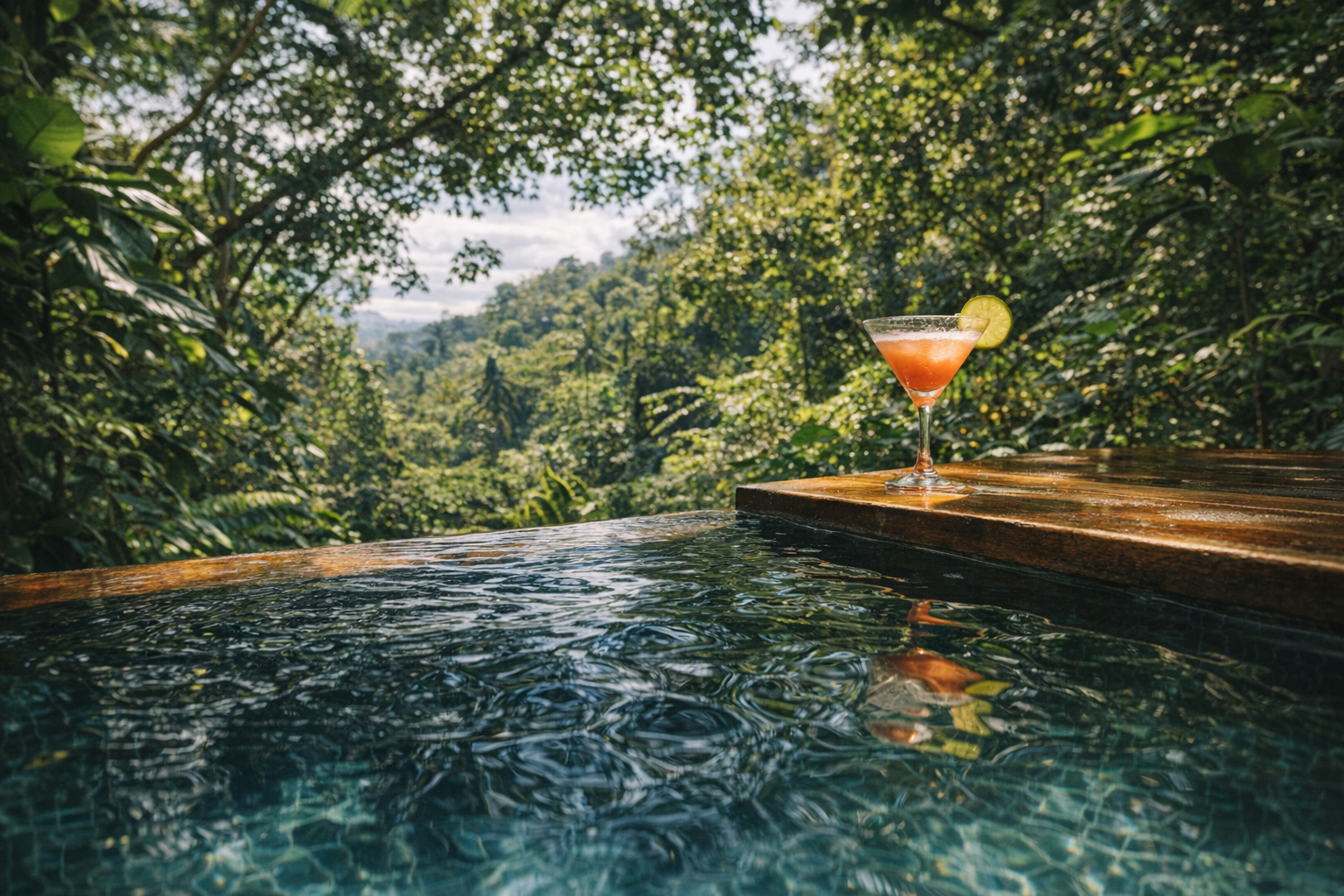
There is a moment that every traveller who has stayed in a private pool villa remembers. It is usually the first morning. You wake without an alarm, walk barefoot through a room that opens directly onto water, and slip into a pool that belongs to no one but you. No towels draped over loungers at dawn. No children cannonballing beside you. No negotiating for shade. Just water, warmth and silence. After that moment, something shifts. The shared resort pool never quite feels the same again.
The private pool did not just change what luxury travellers expect from their accommodation. It changed the entire architecture of the industry. It rewired the economics of hospitality, the design of tropical properties and the very definition of what a premium stay looks like. And it did it all, remarkably, in less than two decades.
The Before Times
For most of the twentieth century, the hotel pool was a communal space. It was the social centre of the resort, a place to see and be seen. The pool was large, shared and positioned for maximum visibility. Cabanas were the closest thing to privacy, and even those were semi-public. The idea that an individual guest might have their own body of water was the stuff of celebrity estates and Bond films, not mainstream hospitality.
The shift began in Southeast Asia in the early 2000s, when a new generation of boutique resorts and private villas started offering individual plunge pools as standard. Bali was at the forefront, where land costs and construction economics made it feasible to offer every room or suite its own pool. What started as a novelty quickly became an expectation.
The Psychology of Private Water
The appeal of a private pool goes far beyond convenience. Water is one of the most psychologically powerful elements in any environment. The sight of it, the sound of it, the sensation of being immersed in it, all produce measurable reductions in cortisol and increases in dopamine. A private pool amplifies these effects by removing the social stress of shared space. You are not performing relaxation. You are actually relaxing.
There is also an element of agency. A private pool is available on your terms, at any hour, in any state of dress, at any pace. This freedom is fundamentally different from the structured access of a resort pool with its operating hours and occupancy pressure. It returns control to the guest, and that sense of autonomy is a core component of genuine luxury.
How It Changed Design
The private pool revolution transformed tropical architecture. Properties could no longer be designed around a single large pool with rooms arranged at a distance. Instead, every living space needed to relate directly to water. This produced the open-plan, indoor-outdoor villa design that has become the signature of luxury tropical accommodation, bedrooms that step directly into pools, living rooms that blur the line between terrace and interior, bathrooms with garden courtyards.
Pool design itself evolved. Infinity edges became standard. Shapes moved from rectangular to organic, following the contours of the landscape rather than imposing geometry on it. Materials shifted from blue mosaic to dark stone, producing water that reflects the sky rather than glowing artificially. The pool became not just an amenity but an architectural element, integral to the design rather than appended to it.
The Economic Ripple
Private pools changed the economics of hospitality in ways that extend far beyond construction costs. Properties with private pools command significantly higher nightly rates, often two to three times the equivalent room without one. This premium has driven an explosion of villa development across Bali, Thailand, the Maldives, Sri Lanka and increasingly parts of Europe and the Caribbean.
It has also shifted the competitive landscape. Five-star hotels that once competed on restaurant quality, spa facilities and lobby grandeur now find themselves competing with private villas that offer none of these communal amenities but deliver something hotels structurally cannot: complete spatial autonomy.
No Going Back
The private pool is now so embedded in the luxury travel vocabulary that its absence feels like an omission rather than the norm. Travellers who have experienced it calibrate their expectations accordingly. It is not indulgence. It has become the baseline.
What the private pool really changed is not the travel industry. It changed the traveller. It taught a generation of guests that luxury is not about access to impressive shared facilities. It is about having your own space, on your own terms, whenever you want it. That lesson, once learned, cannot be unlearned.